

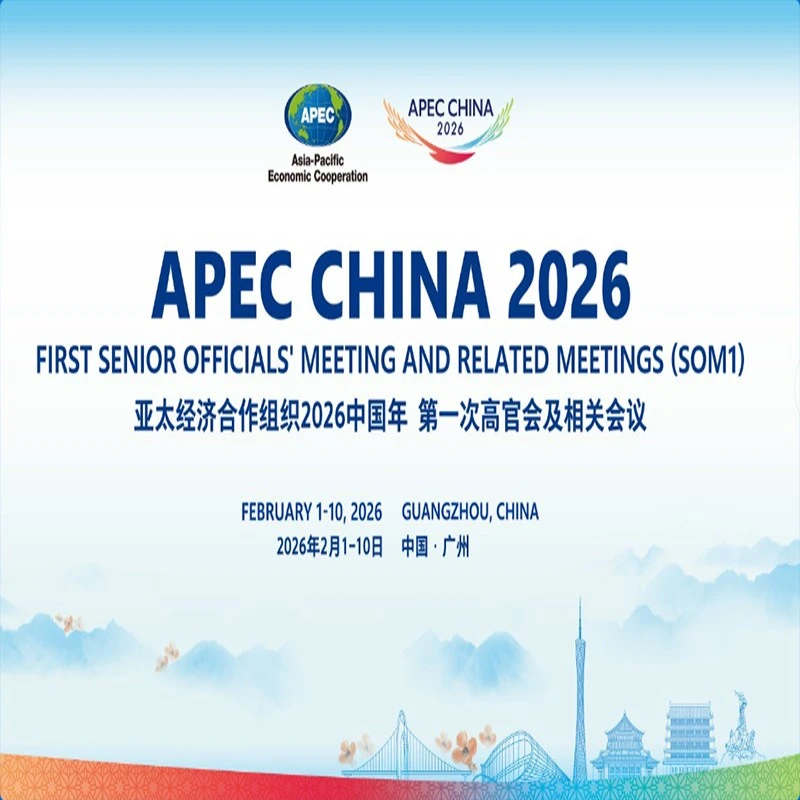
The 33rd APEC Economic Leaders' Meeting was held on 18–19 November 2026 in Shenzhen, Guangdong Province, China. This marks China's third time hosting APEC, with the theme "Building an Asia-Pacific Community for Common Prosperity" and three priority areas: "Openness, Innovation and Cooperation."
Basic Facts
Time and venue: 18–19 November 2026, Shenzhen International Exchange Center. Side events included the CEO Summit and the Joint Ministerial Meeting (foreign and trade ministers).
Theme and priorities: At the APEC Informal Senior Officials' Meeting in December 2025, members unanimously endorsed China's proposed theme, "Building an Asia-Pacific Community for Common Prosperity," along with the three priority areas of "Openness, Innovation and Cooperation."
Scale of the year's programme: As the "APEC China Year," China hosted more than 300 meetings and events in 16 cities over the course of the year, with tens of thousands of delegates from member economies taking part - a record in APEC's history. Ten sectoral ministerial meetings produced more than ten major outcomes, including the Suzhou Statement from the Trade Ministers' Meeting, the Chengdu Statement from the Digital and AI Ministers' Meeting, and the Nanjing Statement from the Human Resources Ministers' Meeting.
Key Outcomes
The most important outcome was the adoption of the APEC Leaders' Shenzhen Outlook, the core deliverable of the "APEC China Year," which advanced the building of an Asia-Pacific community in six areas.
Setting the direction of Asia-Pacific cooperation
In his remarks, President Xi Jinping proposed that, amid a turbulent and changing international landscape, the Asia-Pacific region should jointly build a community of "unity in adversity, openness and connectivity, pioneering innovation, and inclusive development." Leaders at the meeting responded positively, supporting the shift of the Asia-Pacific community from a vision to action.
Establishing the "four pillars and eight supports" architecture
President Xi proposed the "four pillars and eight supports" for building the Asia-Pacific community:
Four pillars: trade and the economy, connectivity, innovation, and development
Eight supports: the Free Trade Area of the Asia-Pacific (FTAAP); hard connectivity of infrastructure; soft connectivity of rules and regulations; people-to-people connectivity; and the digital economy, emerging technologies, capacity building, and sustainable growth
Trade outcomes
This year marks the 20th anniversary of the FTAAP vision. The meeting adopted the APEC Cooperation Framework on Trade Digitalization as an important measure to facilitate trade and support the building of the FTAAP.
Support measures announced by China
President Xi announced that China will provide funding for practical APEC cooperation, establish an Asia-Pacific Community Research Center in Shenzhen, and set up cooperation institutions in areas such as digital technology, cross-border data flows, clean energy, and small and medium-sized enterprise development.
China's Hosting Role and Participation
President Xi chaired the APEC Economic Leaders' Meeting and delivered an important speech. He attended the opening ceremony of the CEO Summit and took part in nearly 20 bilateral and multilateral activities, including chairing the China-Russia-US trilateral summit.
Briefing Chinese and foreign journalists on the outcomes after the meeting, Wang Yi, Member of the Political Bureau of the CPC Central Committee and Foreign Minister, said that against a backdrop of international turbulence, pressure on global growth, and rising anti-globalization sentiment, leaders of the 21 APEC economies gathering in Shenzhen to discuss cooperation is not only of great significance for opening a new chapter in Asia-Pacific cooperation, but will also have a profound impact on safeguarding world peace and development.
Background
This is the third time China has hosted the APEC Economic Leaders' Meeting, following Shanghai in 2001 and Beijing in 2014. Chen Xu, Chair of the 2026 APEC Senior Officials' Meeting, said earlier at a briefing that choosing Shenzhen (in the Guangdong-Hong Kong-Macao Greater Bay Area) as the venue reflects the region's growing importance; delegates from member economies spoke highly of the Greater Bay Area's development momentum during their visits.